The Micro-Story Method: Brain-Building Parenting Every Child Needs
A science-backed, parent-friendly guide to using tiny stories for emotional regulation, smoother routines, and secure attachment.


Responsive, attentive relationships with caring adults form the strongest foundation for a child’s brain architecture and lifelong wellbeing. When a child expresses an emotion through behaviour, hesitation, or words and an adult responds with warmth, eye contact, or imagination, this back-and-forth exchange strengthens the neural circuits responsible for communication, emotional regulation, and social skills.
This interaction, known as serve-and-return, is one of the most powerful experiences the developing brain depends on. According to the Center on the Developing Child at Harvard University, responsive exchanges “build and strengthen neural connections that support all future learning, behaviour, and health” (Harvard, 2021).
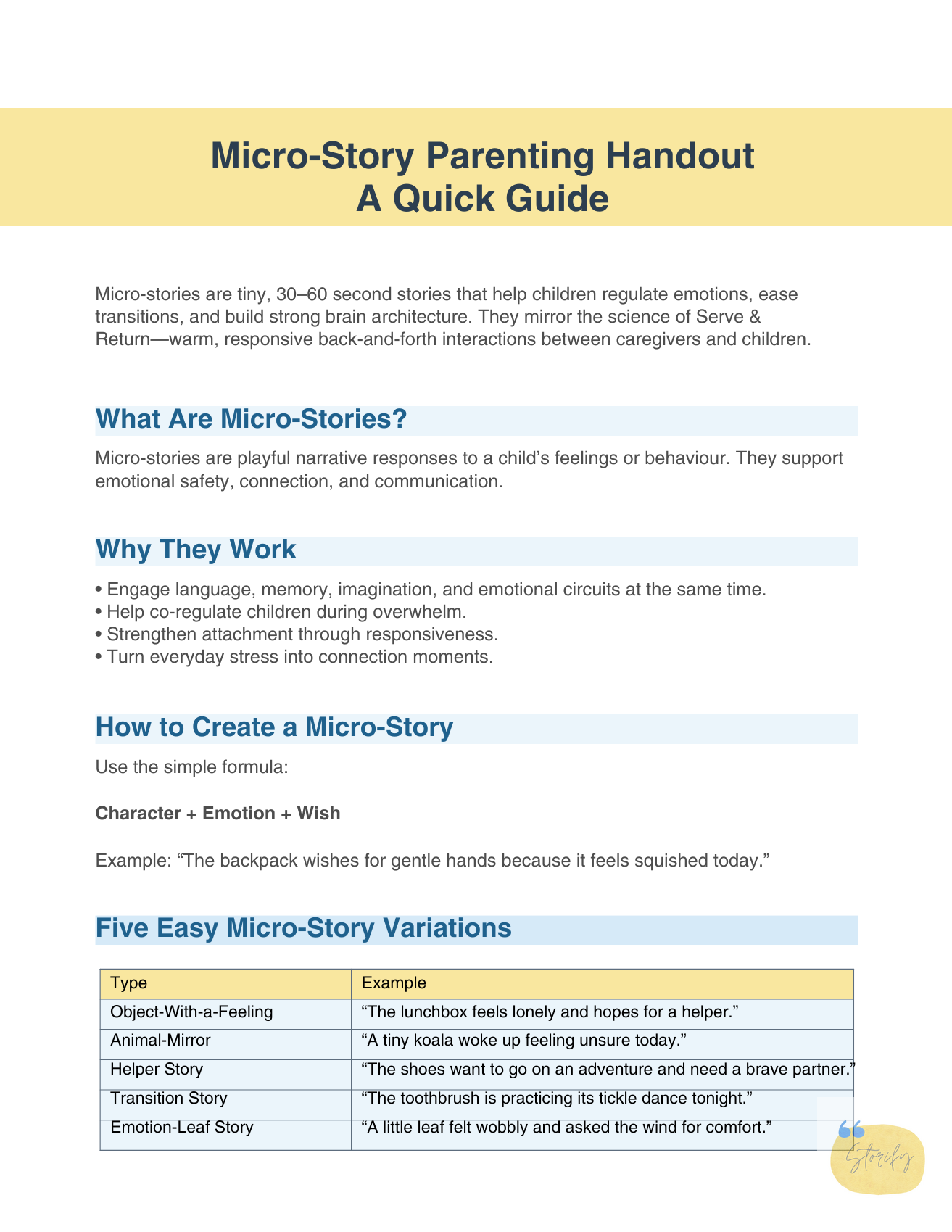
Stories, especially micro-stories, are among the most accessible forms of serve and return. A parent offers a tiny narrative; the child responds with curiosity, emotion, or engagement. In that brief moment, connection becomes the foundation for learning.
Stories build brain architecture through multi-system engagement
Much like the lively back-and-forth of serve and return, storytelling engages multiple brain systems at once. Even a short, improvised narrative activates auditory, visual, emotional, linguistic, and memory networks. Harvard’s work on brain development shows that experiences that activate multiple neural systems simultaneously support a stronger, more integrated architecture.
Activities teach skills. Stories teach interpretation, sequencing, empathy, and imagination.
Stories are more effective in regulating the nervous system
When children experience overwhelm, their reasoning brain temporarily goes offline. Traditional behaviour regulation approaches, such as consequences or instructions, often fail because the nervous system remains activated. But stories work differently.
They activate imagery, metaphor, and relational meaning, which signal safety to the nervous system.
So what do we need to build a long-term parent-child bond and ensure the child’s well-being?
Micro-moments of shared storytelling
We need micro-moments of shared storytelling. Harvard’s serve-and-return emphasises that the developing brain expects stable, responsive interactions, and that their absence can lead to stress-related disruptions.
Story exchanges function like emotional serve and return:
The child “serves” through behaviour or emotion.
The parent “returns” by turning the moment into a shared narrative.
These micro-moments build connection, helping children feel safe, seen, and supported, which are building blocks of developing secure attachment and resilience. This is why even 60 seconds of micro-storytelling can lead to deeper connection and emotional learning.
So think twice before letting your child’s ‘serve’ signals slip away to your own screen time. Those micro-moments of missed connection are worth more than an hour of structured activity later.
Further resources to practice responsive interactions
5 Steps for brain building serve and return